Pakistani ambassador hails Iran's crash test center as successful private sector model
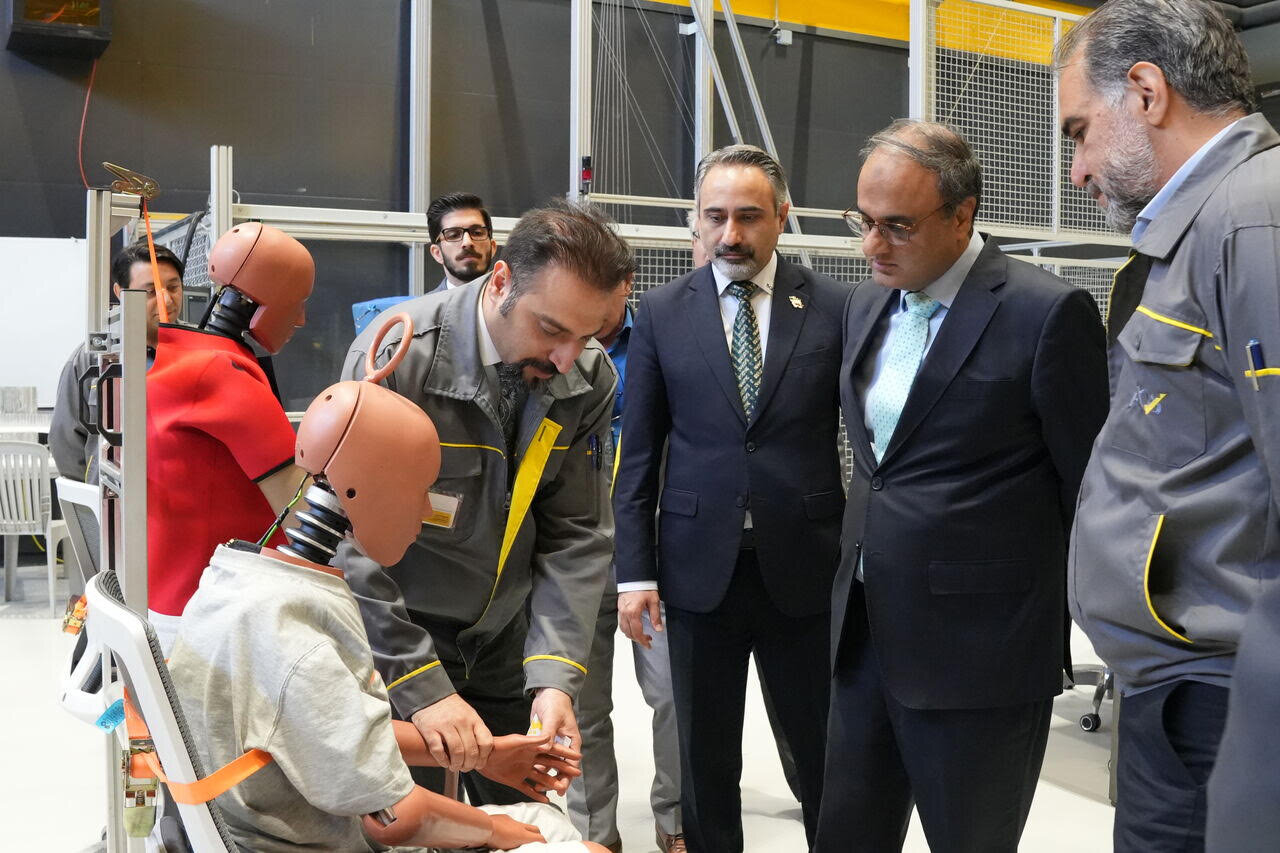
TEHRAN - Pakistan's ambassador to Iran has described the crash test center as a successful example of Iran's private sector, stating: "We can begin this cooperation by drafting and signing a preliminary agreement. We hope that conditions will soon move in a direction that allows us to provide the necessary and additional infrastructure to expand this cooperation."
According to a Wednesday report by IRNA from the Automotive Safety and Quality Testing Company (AQS), Pakistani Ambassador Imran Ahmed Siddiqui, during a visit to the automotive test center, praised the facility as a successful model of Iran's private sector and expressed his satisfaction with the opportunity to tour the site.
The Pakistani ambassador also responded to proposals regarding bilateral cooperation in the automotive sector, discussing the feasibility study of cooperation conditions, as well as holding webinars and online training sessions for automakers and parts manufacturers in the Pakistani market.
Imran Ahmed Siddiqui, referring to current conditions and political constraints, said: "Given the present situation, we can initiate this cooperation by drafting and signing a preliminary agreement. We hope that conditions will soon progress in a way that allows us to provide the necessary and greater infrastructure for expanding this cooperation."
Subsequently, the Pakistani delegation toured all facilities and sections of the crash test center. At the end of the visit, a mandatory COP (Conformity of Production) frontal impact test was conducted on one of the country's vehicles in the presence of a representative from Iran's National Standards Organization. The results will be shared with the automaker and the organization after analysis.
Private sector steps toward realizing $10-billion Iran-Pakistan trade vision
At the beginning of the meeting, the Chairman of the Board of Directors of the Iran Quality and Standard Inspection Company welcomed the Pakistani delegation and described the automotive crash test center as the only and largest testing facility in Iran. Saeed Tajik stated: "This center was launched last year with full private sector investment and a major stake held by the Iran Quality and Standard Inspection Company, aimed at reducing traffic accident fatalities."
Tajik noted the significant accident statistics on Pakistan's roads and addressed areas of cooperation with Pakistani automakers and parts manufacturers in crash testing, as well as engagement with Pakistan's Standards Organization, as a shared commercial opportunity between the two countries.
Hesameddin Hallaj, Deputy for International Affairs and Trade Development at the Tehran Chamber of Commerce, also viewed the visit as a timely opportunity for bilateral cooperation and expressed optimism about interactions between Iranian and Pakistani companies.
Referring to the Iran Expo 2026, scheduled to be held in November, he announced readiness for a Pakistani trade delegation, facilitated by the Tehran Chamber of Commerce, to participate in the event, visit the testing center, and engage in commercial exchanges.
Notably, crash tests such as R 94, 95, and 34 have recently become mandatory in Pakistan, and the visit was conducted to enable Pakistani automakers and parts manufacturers to utilize Iran's crash test center.
Iran and Pakistan took a significant step toward deepening economic ties, signing a memorandum of understanding to expand trade cooperation during the 10th session of the Joint Trade Committee held in Islamabad, in early August. Both sides reaffirmed their mutual commitment to achieving the ambitious $10 billion target in bilateral trade and advancing toward a formal free trade agreement.
The final session of the committee was attended by Iran's Minister of Industry, Mining and Trade, Seyyed Mohammad Atabak, and his Pakistani counterpart, Jam Kamal Khan. The MOU was signed following extensive deliberations that covered a wide range of commercial cooperation areas, including joint border regions, maritime activities and shipping development, coordinated steps for a free trade agreement, establishment of joint free zones, and barter trade mechanisms.
Speaking at the signing ceremony, Minister Atabak described the negotiations as highly constructive. "Overall, we had good negotiations with Pakistani officials. We also held an important meeting with the Federation of Chambers of Commerce of this country, and everyone emphasized the expansion of interactions between the two nations," he said.
Atabak noted that the talks over the past two days were specifically aimed at increasing trade relations between Iran and Pakistan. "Of course, in some cases, there is a need for facilities and removal of obstacles, and it was agreed that the Pakistani side would continue new follow-ups in this regard," he added.
The minister emphasized that Iran places no restrictions on increasing trade volume with Pakistan. "We call on the business communities of both countries to play their essential role in this direction," he stated, reinforcing Iran's principled policy of expanding cooperation with neighbors and, where necessary, supplying its needed goods from neighboring countries.
Key aspects of the MOU include activating border regions, increasing border exchanges with a focus on private sector engagement, exchanging technical delegations, and immediately operationalizing existing bilateral agreements. Ministry officials from both countries have been tasked with formulating implementation mechanisms.
On the sidelines of the committee session, a specialized meeting was held at the Federation of Pakistan Chambers of Commerce and Industry (FPCCI) in Islamabad, hosted by FPCCI President Atif Ikram Sheikh and senior officials representing chambers from various Pakistani cities.
Sheikh emphasized the historical depth of Iran-Pakistan relations, noting that the two nations are not just decades-old but centuries-old partners who have supported each other through every difficult period. He highlighted that the Pakistani government, business community, and people had fully supported their Iranian brothers during recent crises in West Asia.
"Despite having long borders, the two countries have not utilized their capabilities in mutual trade," Sheikh acknowledged. "This is a serious demand of economic activists and traders of Iran and Pakistan, and we must take more steps to benefit from each other's capabilities and secure our interests."
Minister Atabak expressed satisfaction with the constructive meeting, stating that such high-level interactions are continuously necessary to facilitate immediate and sustainable resolution of issues. "Pakistan and Iran are not only neighbors, but their relations are rooted in history, religion, and social cooperation," he said, adding that important proposals put forward by business communities from both countries would yield positive results.
During the ceremony, a separate cooperation memorandum was also signed between the Iran Chamber of Commerce and Industries and the Federation of Pakistan Chambers of Commerce and Industry, further institutionalizing private-sector engagement.
MA
Leave a Comment